ogmini - Exploration of DFIR
Having fun while diving into the world of DFIR / 4n6.
About Blog Posts by Tags Research Talks/Presentations GitHub Search RSS
Magnet Virtual Summit 2026 CTF - AAR Cipher Challenges
by ogmini

Below are my writeups for the Cipher Pre-Challenges from the recent MVS 2026 CTF.
Can you Handle this one?
Hi Jessica! 00110110 00111000 00100000 00110111 00110100 00100000 00110111 00110100 00100000 00110111 00110000 00100000 00110111 00110011 00100000 00110011 01100001 00100000 00110010 01100110 00100000 00110010 01100110 00100000 00110111 00110011 00100000 00110111 00110100 00100000 00110110 00110001 00100000 00110111 00110010 00100000 00110111 00110100 00100000 00110110 01100100 00100000 00110110 00110101 00100000 00110010 01100101 00100000 00110111 00110011 00100000 00110111 00110100 00100000 00110110 00110001 00100000 00110111 00110010 00100000 00110110 01100010 00100000 00110011 00110100 00100000 00110110 01100101 00100000 00110011 00110110 00100000 00110010 01100101 00100000 00110110 00110011 00100000 00110110 01100110 00100000 00110110 01100100 00100000 00110010 01100110
This looks like binary. Some give aways are the 0s and 1s and the grouping of 8. Using CyberChef we can convert from Binary. CyberChef From Binary
68 74 74 70 73 3a 2f 2f 73 74 61 72 74 6d 65 2e 73 74 61 72 6b 34 6e 36 2e 63 6f 6d 2f
This output looks like Hex. CyberChef From Hex
Jessica Hyde had also given a very big hint on LinkedIn - https://www.linkedin.com/posts/hydejessica_dfir-ctf-activity-7417910498744016896-Pdzf?utm_source=share&utm_medium=member_desktop&rcm=ACoAAADfdBEBELHpzRkuF5mAh39sI_EZfTyW4lg. Bin2Hex or Binary to Hex.
Answer: https://startme.stark4n6.com/
Peel Back the Layers
Can you find the hidden link? (Provide the redirected resource URL)
File Download: ThisIsFine.pxz
This is a PXZ file which is a zip file of .webp image files and a JSON Manifest used by https://pixlr.com/. We can unzip the file and examine the individual files.
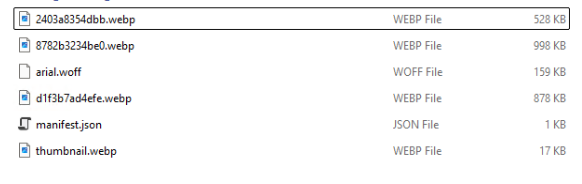
I first checked the manifest.json file and saw http://tiny.cc/7h5v001. The classic RickRoll and this is not the answer.
{
  "id": "b13faf49-01ce-4a21-9739-3e89e56a33c0",
  "name": "Untitled(2)",
  "type": "document",
  "unit": "pixel",
  "width": 1000,
  "height": 1000,
  "stack": [
    {
      "name": "Flag???",
      "type": "image",
      "rect": {
        "x": 0,
        "y": 0,
        "w": 1019,
        "h": 1019,
        "r": 0
      },
      "opacity": 1,
      "locked": false,
      "visible": true,
      "link": "",
      "content": "2403a8354dbb.webp"
    },
    {
      "name": "Flag???",
      "type": "image",
      "rect": {
        "x": 8,
        "y": 84,
        "w": 984,
        "h": 858,
        "r": 0
      },
      "opacity": 1,
      "locked": false,
      "visible": true,
      "link": "",
      "content": "8782b3234be0.webp"
    },
    {
      "name": "Flag??",
      "type": "text",
      "rect": {
        "x": 89,
        "y": 444,
        "w": 833,
        "h": 78,
        "r": 0
      },
      "opacity": 1,
      "locked": false,
      "visible": true,
      "link": "",
      "content": "http://tiny.cc/7h5v001",
      "format": {
        "size": 60,
        "align": "center",
        "bold": false,
        "italic": false,
        "underline": false,
        "uppercase": false,
        "linespace": 0,
        "letterspace": 0,
        "font": {
          "name": "Arial",
          "content": "arial.woff"
        },
        "fill": {
          "type": "color",
          "value": "#ffffff"
        }
      }
    },
    {
      "name": "Flag?",
      "type": "image",
      "rect": {
        "x": -242,
        "y": -23,
        "w": 1485,
        "h": 1047,
        "r": 0
      },
      "opacity": 1,
      "locked": false,
      "visible": true,
      "link": "",
      "content": "d1f3b7ad4efe.webp"
    }
  ]
}
I checked the various image files and found some very light gray text in 2403a8354dbb.webp which points to http://tiny.cc/nh5v001 which redirects to https://github.com/abrignoni.

Peel back the layers was a reference to the zip file.
Answer: https://github.com/abrignoni
Good Grief
The Great Pumpkin’s Inverse Logic
File Download: VanPelt.png

The image is a Pigpen Cipher which decodes to WLFYOVYOZP. This is an Atbash Cipher. Using CyberChef Atbash Cipher we can decode the answer of DOUBLEBLAK which is a reference to https://www.doubleblak.com/
We had a few hints on this one. Good Grief! was a reference to Peanuts the comic. VanPelt.png is a reference to Linus Van Pelt. Hexordia provided another hint https://www.linkedin.com/posts/hexordia_mobileforensics-dfir-forensictraining-activity-7422664920581746688-XmZn of “Even the messiest members of the gang can play!”. This references the character Pig Pen from Peanuts. Pig Pen was a hint towards the pigpen cipher and the “Inverse Logic” in the description hints to the Atbash Cipher.
Answer: DOUBLEBLAK
Resident Evil
Can you find the link?
File Download: Challenge3.vhdx
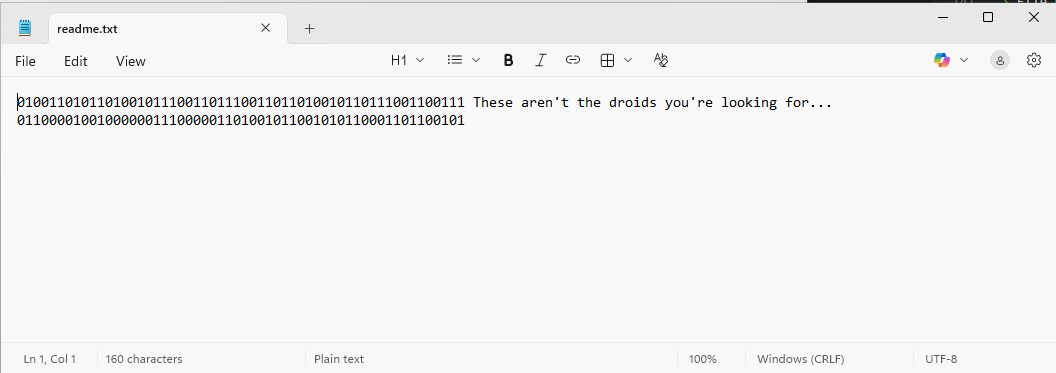
Mounting the vhdx file and we can see it contains a readme.txt file with an obvious fake answer (“These aren’t the droids you’re looking for…”). Decoding the binary with CyberChef has the author taunting us with a possible hint of “Missing a piece”.
Load up the disk into Autopsy and start poking around. The $MFT file and $MFTMirr file can often times contain remnants of files and other useful information. It can be a way to recover deleted or changed files.
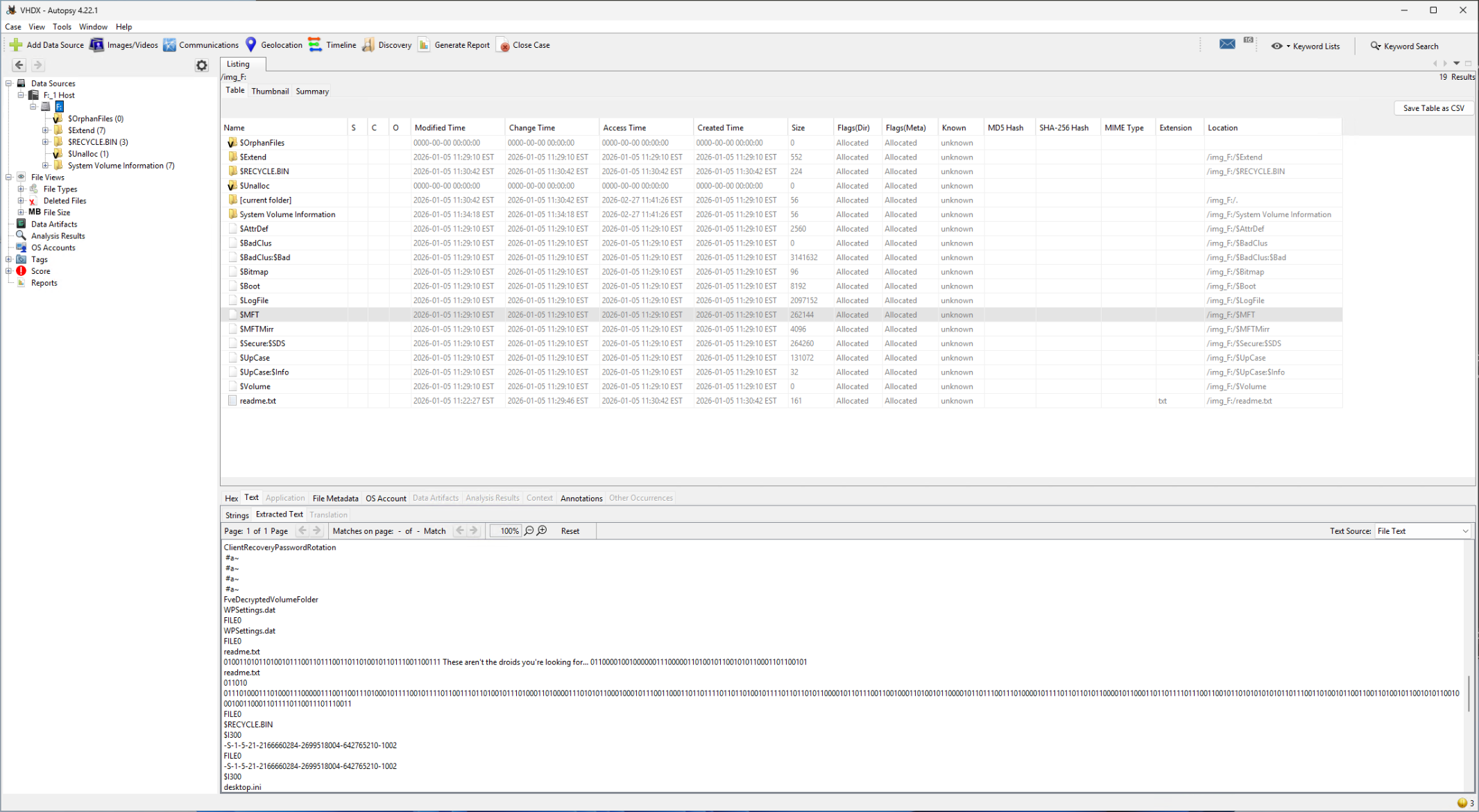
We can already sort of see the answer in the “Extracted Text” and dumping the binary into CyberChef gives us ttps://github.com/mandiant/macos-UnifiedLogs which should obviously be https://github.com/mandiant/macos-UnifiedLogs
I extract the $MFT file and examine it with 010 Editor just for some more context.
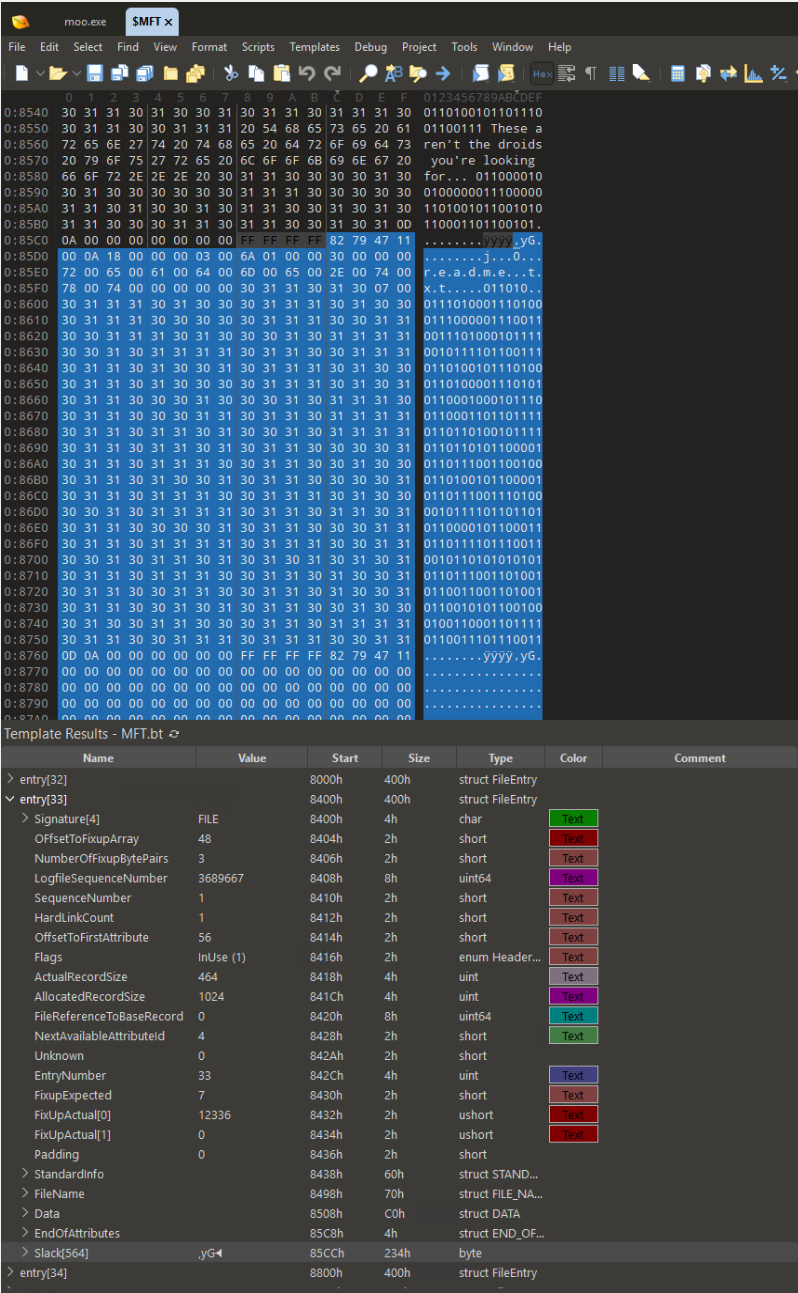
In the slack space for the MFT Entry 33, we observe the following:
011010..0111010001110100011100000111001100111010001011110010111101100111011010010111010001101000011101010110001000101110011000110110111101101101001011110110110101100001011011100110010001101001011000010110111001110100001011110110110101100001011000110110111101110011001011010101010101101110011010010110011001101001011001010110010001001100011011110110011101110011
It is pretty clear that we are missing some 0s and 1s. 011010 most likely should be 01101000 which translates to “h” completing our URL.
I’m unsure of the hints on this one if it even had any.
Answer: https://github.com/mandiant/macos-UnifiedLogs
Bonsoir Elliot
It’s not that Deep, just Sound it out (shout out to int80)
File Download: HideNSeek.wav
We are given a wav file. There is a BIG hint in the description. “It’s not that Deep, just Sound it out (shout out to int80)” Points to DeepSound. int80 is the nerdcore rapper.
Using the DeepSound tool from https://github.com/Jpinsoft/DeepSound allows us to extract a secret.txt file which contains https://dfir.blog/unfurl/.
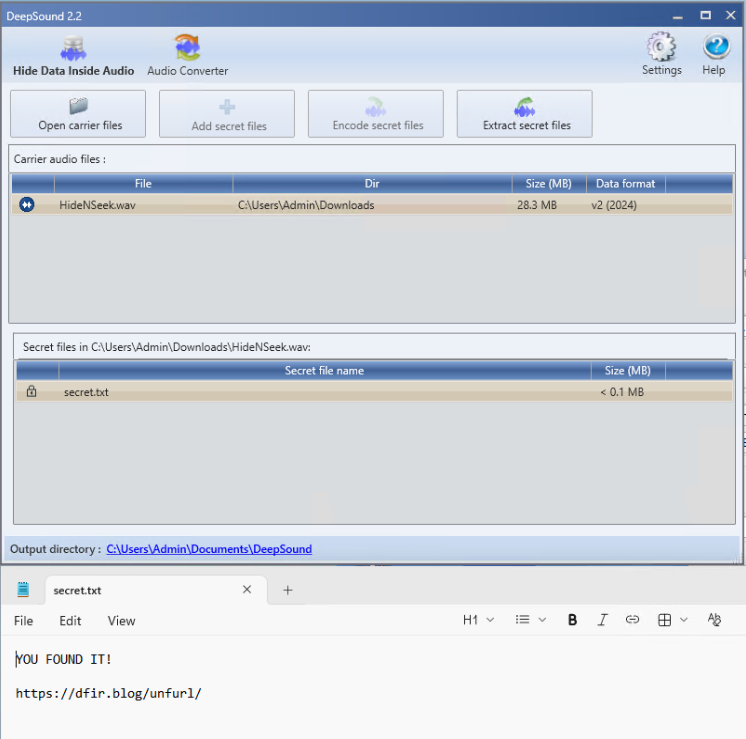
Answer: https://dfir.blog/unfurl/
Cows come in all shapes and sizes
Moooo! Get the cow to spill the secret! (zip password: moo)
File Download: moo.zip
I went really off track with this challenge! What follows are all the steps I took including the missteps.
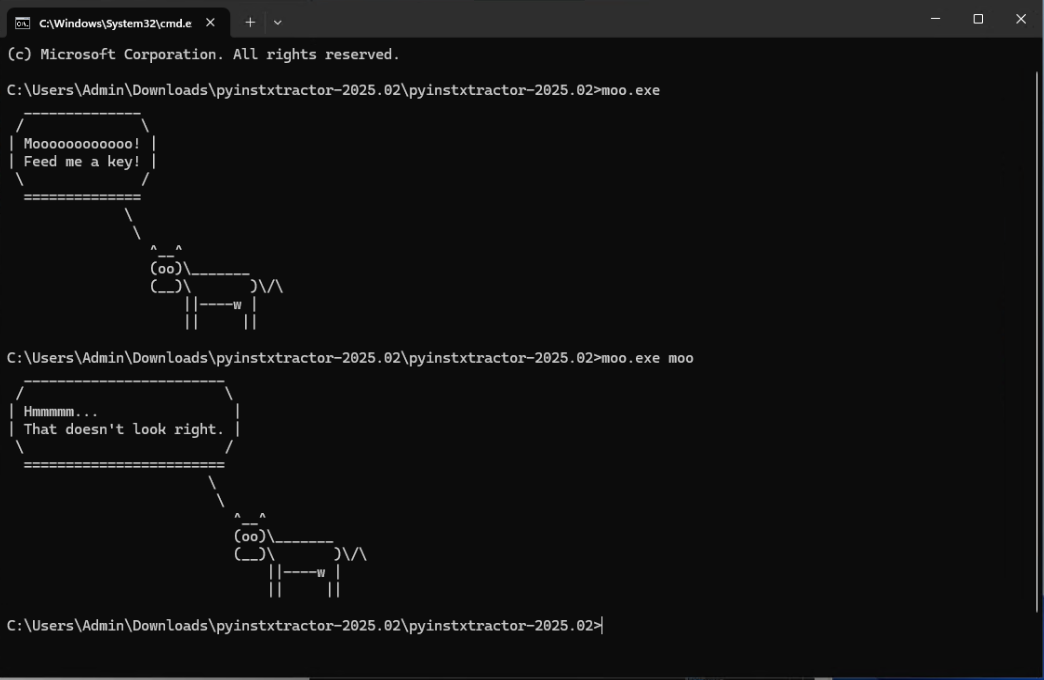
Running the program shows us cowsay. It obviously wants an argument and providing one results in the cow yelling at us about the wrong key.
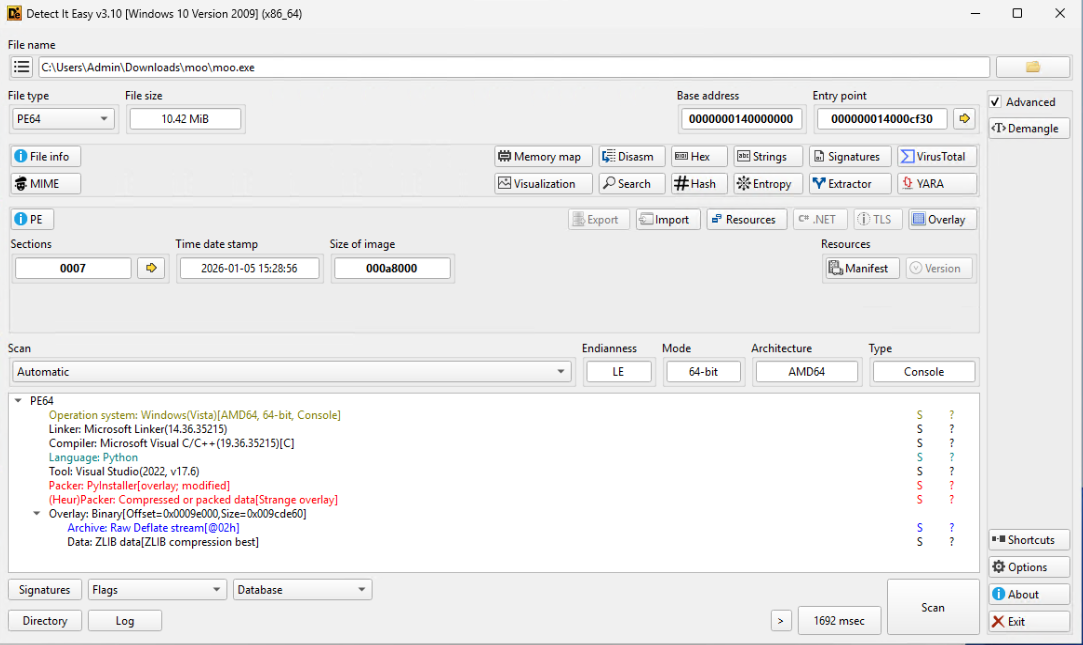
Using Detect It Easy, I identify the executable as a Python script packed with pyinstaller.
I next use pyinstxtractor to unpack the Python script and find compiled python bytecode.
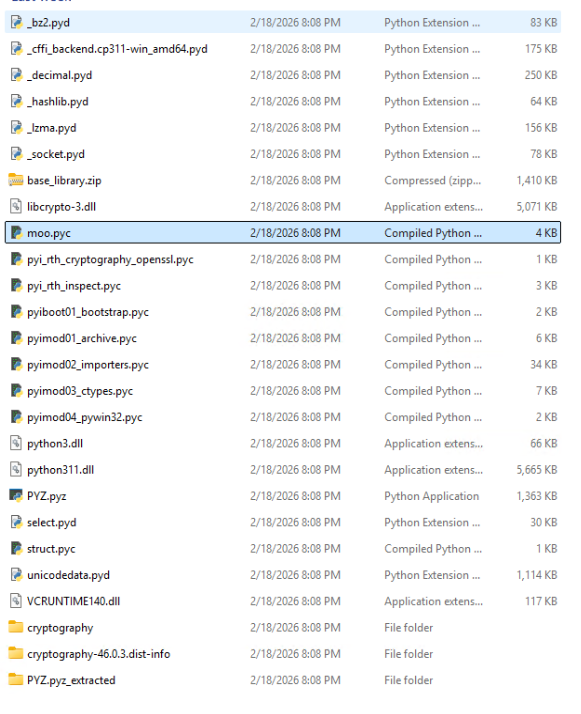
I take the moo.pyc and upload it to https://www.pylingual.io/ to decompile the python bytecode. As a sidenote, there are other tools such as https://github.com/rocky/python-uncompyle6. Sadly, I missed the author’s presentation at BSides NYC 0x05. I get the following:
# Decompiled with PyLingual (https://pylingual.io)
# Internal filename: 'moo.py'
# Bytecode version: 3.11a7e (3495)
# Source timestamp: 1970-01-01 00:00:00 UTC (0)

import sys
import base64
from cryptography.hazmat.primitives.ciphers import Cipher, algorithms, modes
from cryptography.hazmat.primitives.kdf.pbkdf2 import PBKDF2HMAC
from cryptography.hazmat.primitives import hashes
from cryptography.exceptions import InvalidTag
from cryptography.hazmat.backends import default_backend
import cowsay
SALT = 'Wx8ah0DALPJAWMS93dm/QA=='
NONCE = 'Tby9ej9/2rDEtRI1'
TAG = 'dDzVexYRxvP/iaVfXA14sg=='
CIPHERTEXT = '3G/8hjWYbdwMGSRLbbOUADqYVYWnZg=='
ITERATIONS = 600000
KEY_SIZE = 32
def decrypt_message(password_attempt):
    try:
        salt = base64.b64decode(SALT)
        nonce = base64.b64decode(NONCE)
        tag = base64.b64decode(TAG)
        ciphertext = base64.b64decode(CIPHERTEXT)
        password = password_attempt.encode('utf-8')
        kdf = PBKDF2HMAC(algorithm=hashes.SHA256(), length=KEY_SIZE, salt=salt, iterations=ITERATIONS, backend=default_backend())
        derived_key = kdf.derive(password)
        decryptor = Cipher(algorithms.AES(derived_key), modes.GCM(nonce, tag), backend=default_backend()).decryptor()
        plaintext = decryptor.update(ciphertext) + decryptor.finalize()
        cowsay.cow(f"Mooooooo! You found the answer!\n{plaintext.decode('utf-8')}")
    except InvalidTag:
        cowsay.cow('Hmmmmm...\n That doesn\'t look right.')
    except Exception as e:
        cowsay.cow(f'What\'s happening?!?!\n{e}')
def main():
    if len(sys.argv)!= 2:
        if len(sys.argv) > 2:
            cowsay.cow('Moooooooooooo!\n TMI!')
        else:
            cowsay.cow('Moooooooooooo!\n Feed me a key!')
        sys.exit(1)
    password_attempt = sys.argv[1]
    decrypt_message(password_attempt)
if __name__ == '__main__':
    main()
After reading the code, there is no tricking this as the program itself is essentially a decryptor. I have to give it the encrypted string. Bruteforcing this is also not a realistic option.
Going back to Detect It Easy, I look a little closer at what it has found within the executable. Under the resources section we find some suspect PNG files.
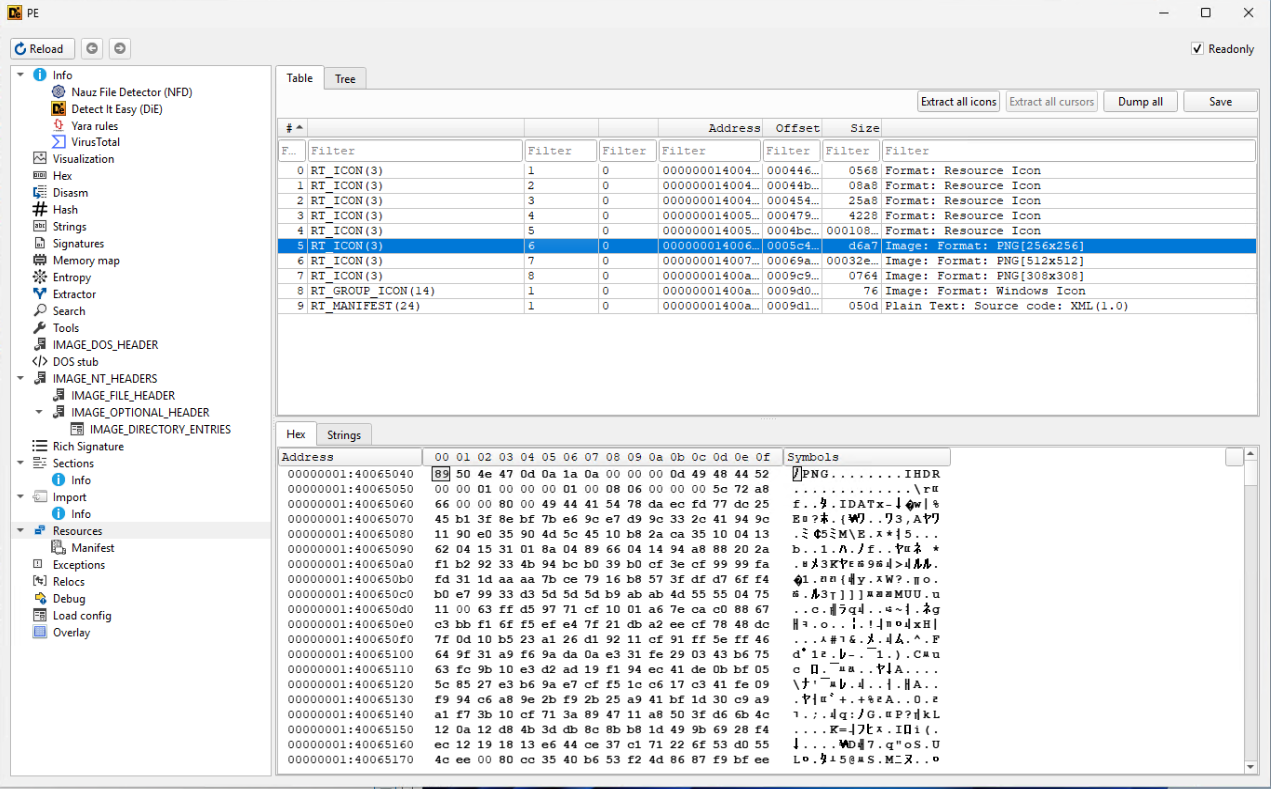
I dump them to files, examine them, and find an interestind barcode.

To read the barcode, I upload it to https://online-barcode-reader.inliteresearch.com/. This is a Pdf417 barcode which reads as 7e0d78a5af1cae300cddbce0f9be3232f32cc5f428e45c36e52f8087ee0a and feeding that key to the cow gives:
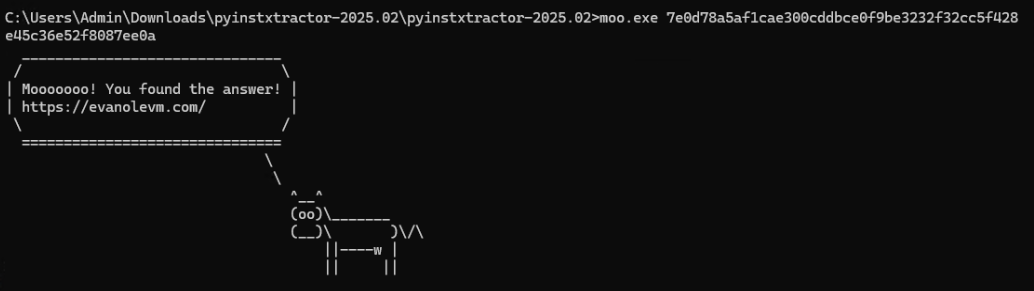
Hexordia provided a small hint on this one at https://www.linkedin.com/posts/hexordia_mobileforensics-dfir-forensictraining-activity-7430362826969534464-TcPv. Saying “You may WREStle with this one.” which points to RES or the resource section of the exe.
Answer: https://evanolevm.com/
tags: #CTF #Challenges